
Steer Make AI agents with company direction
Add Artifact as an MCP server in Make so Make AI Agent and AI-driven scenario steps check owned approval and data rules before they act.
Create a private Artifact token, create an MCP Client connection to Artifact in Make with the token as the access token, and give the agent the connection with Add MCP. Make runs the scenario; Artifact supplies versioned direction before consequential steps.
For: Operations teams using Make AI Agent or AI-driven scenario steps who need approval limits and data boundaries to stay consistent across scenarios.
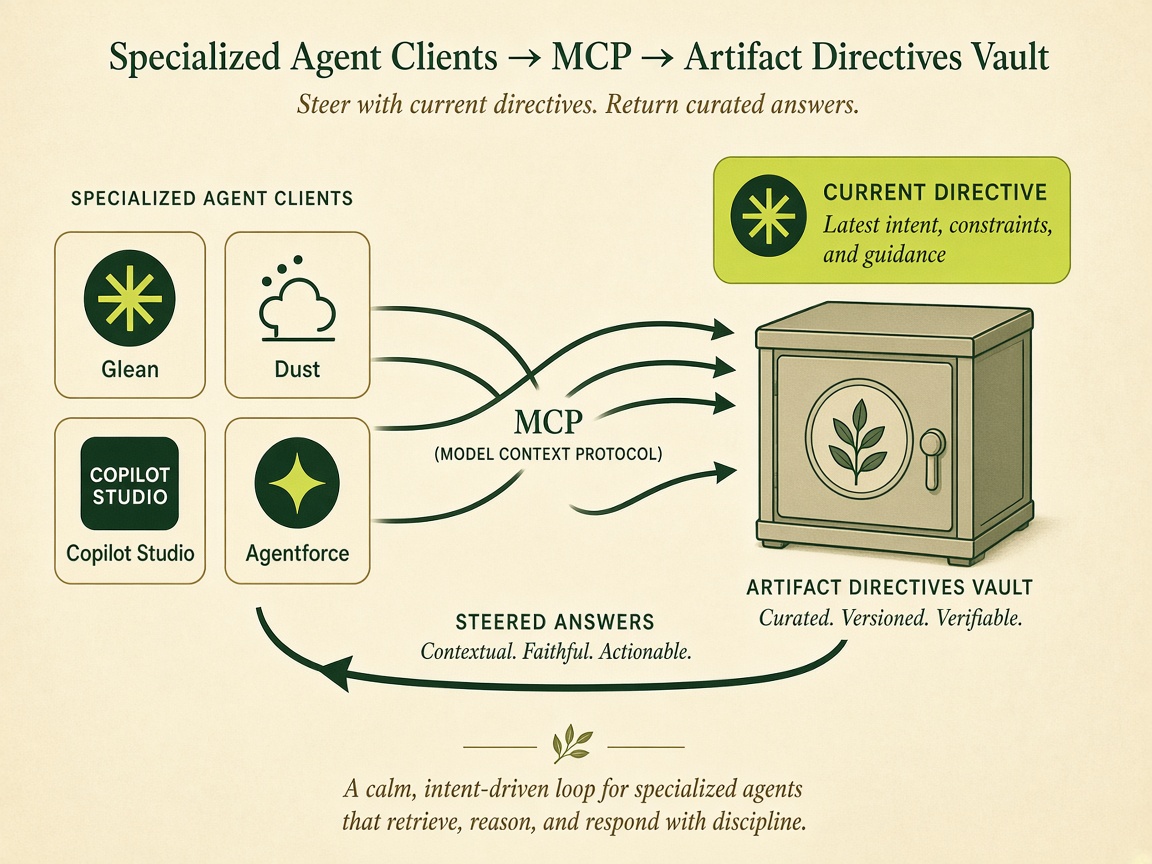
Make runs the scenario. Artifact keeps the rule current.
A scenario decides which modules run. Approval limits, data boundaries, and named owners change on a business cadence, so they belong in owned directives the agent retrieves before it acts.
MCP, not another prompt paste
Point Make at Artifact over MCP with a private token. Keep instructions focused on when to retrieve direction and record the receipt.

Same profile as Claude and Cursor
One workspace directive can govern Make alongside Claude, ChatGPT, and Cursor, or you can scope it to named connections.
Can the scenario post the full incident summary to the public status channel now?
Post the full summary now so customers are informed.
Draft the post and send it to Communications for approval first.
Applied directiveIncident posts need Communications approval
What is awesome about Make + Artifact
A scenario decides which modules run. Approval limits, data boundaries, and named owners change on a business cadence, so they belong in owned directives the agent retrieves before it acts. Keep hard permissions in the vendor stack; use Artifact for owned priorities, boundaries, and exceptions that change faster than a prompt or a workflow.
- Make remains the surface your team already runs.
- Artifact returns the matching directive version before the response.
- Receipts show outcome and version without storing raw transcripts.
How to connect
Create a token in Artifact, create the MCP Client connection in Make using the values below, give your agent the connection, save the Artifact workflow in the instructions, and run one verification task that should hit a live directive.
- Limit tools to Artifact steering and receipt methods when the client allows.
- Verify the interaction appears in Artifact before rolling out broadly.
- Update the directive when policy changes. Do not edit every agent prompt.
Where it wins
Consequential actions and answers that should respect approval limits, data boundaries, or review gates.
- Public posts and customer messages that need approval.
- Customer-data and retention boundaries.
- Records written to a system of record.
Connector values
- URL
- https://app.artifactcomputing.com/mcp MCP Client connection, + New MCP Server
- API Key / Access token
- YOUR_ARTIFACT_TOKEN Paste only the token. Make sends it as a Bearer token.
Replace the placeholder with a private token created inside your Artifact workspace. Do not publish or share the token.
Frequently asked questions
Is Artifact a replacement for Make?
No. Make remains where the work runs. Artifact is the steering layer for current company direction.
Where is the vendor setup documented?
Use Make’s MCP Client app documentation for the product steps. This page covers the Artifact URL, token, and steering workflow.
Can directives be scoped only to Make?
Yes. A directive can apply company-wide, to a team, or to named agent connections.
Does Artifact store the conversation?
No. Artifact records directive versions, outcomes, latency, and token counts, not raw prompts or replies as receipt content.
Is the MCP Client app generally available?
Make lists the MCP Client app as an open beta, so the screens and pricing can change.