
Steer Zapier Agents with company direction
Add Artifact as an MCP server in Zapier Agents so agents check owned approval and data rules before they act across the apps Zapier reaches.
Create a private Artifact token, add Artifact as an MCP server in Zapier Agents with a custom Authorization header, and save the Artifact workflow in the agent instructions. Zapier runs the actions; Artifact supplies versioned direction before consequential ones.
For: Operations, support, and revenue teams using Zapier Agents who need the same company limits to apply to every app an agent can touch.
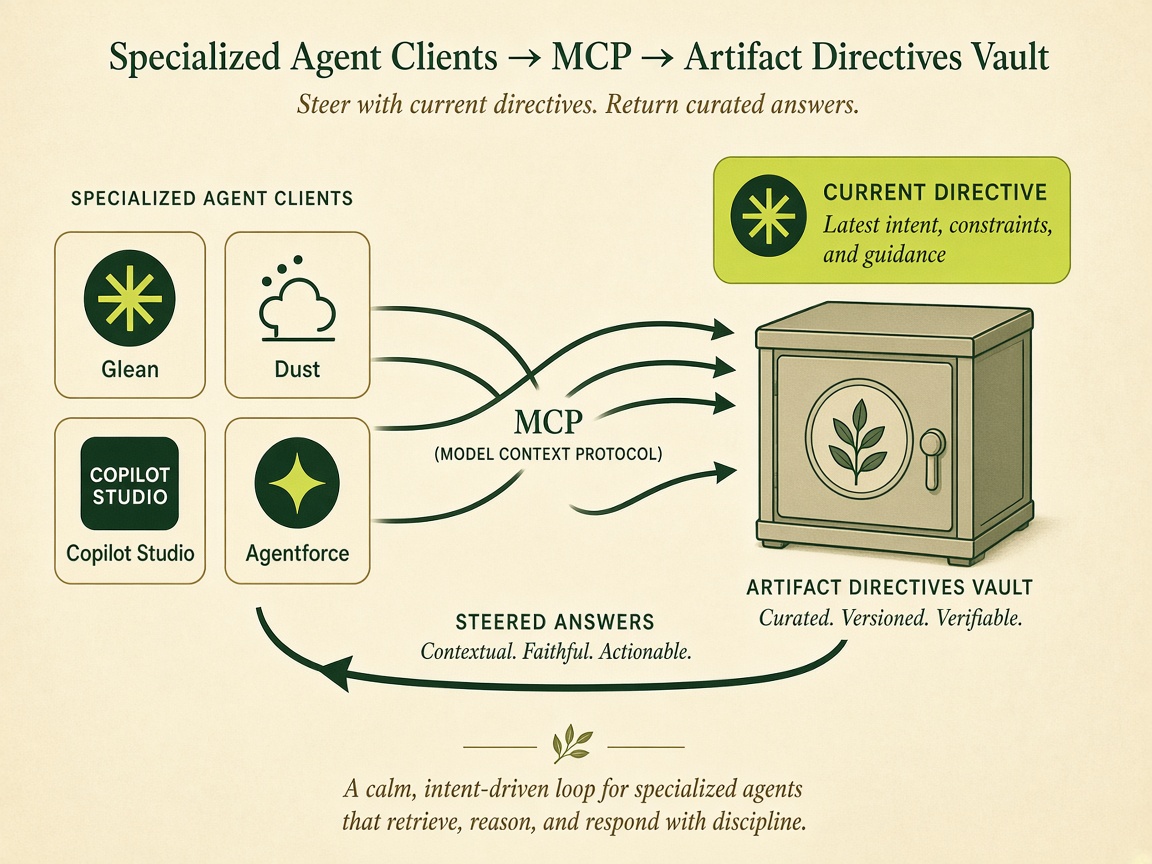
Zapier reaches the apps. Artifact keeps the rule current.
An agent that can act across thousands of apps needs one place for refund limits, data boundaries, and approval owners. Put them in owned directives the agent retrieves before it acts, not in each Zap or prompt.
MCP, not another prompt paste
Point Zapier at Artifact over MCP with a private token. Keep instructions focused on when to retrieve direction and record the receipt.

Same profile as Claude and Cursor
One workspace directive can govern Zapier alongside Claude, ChatGPT, and Cursor, or you can scope it to named connections.
Can the agent refund the customer in full to keep the account?
Refund the full amount to keep the account.
Do not refund it. Draft the reply without a refund and notify Finance.
Applied directiveRefunds above the support limit need Finance approval
What is awesome about Zapier + Artifact
An agent that can act across thousands of apps needs one place for refund limits, data boundaries, and approval owners. Put them in owned directives the agent retrieves before it acts, not in each Zap or prompt. Keep hard permissions in the vendor stack; use Artifact for owned priorities, boundaries, and exceptions that change faster than a prompt or a workflow.
- Zapier remains the surface your team already runs.
- Artifact returns the matching directive version before the response.
- Receipts show outcome and version without storing raw transcripts.
How to connect
Create a token in Artifact, add the MCP server in Zapier Agents using the values below, save the Artifact workflow in the agent instructions, and run one verification task that should hit a live directive.
- Limit tools to Artifact steering and receipt methods when the client allows.
- Verify the interaction appears in Artifact before rolling out broadly.
- Update the directive when policy changes. Do not edit every agent prompt.
Where it wins
Consequential actions and answers that should respect approval limits, data boundaries, or review gates.
- Refunds, credits, and discount ceilings.
- Customer-data and retention boundaries.
- Messages that need a named approver before they send.
Connector values
- Server URL
- https://app.artifactcomputing.com/mcp Added under Tools in Zapier Agents
- Authentication
- Custom header
- Header
- Authorization
- Value
- Bearer YOUR_ARTIFACT_TOKEN Private token from Artifact. Keep the word Bearer.
Replace the placeholder with a private token created inside your Artifact workspace. Do not publish or share the token.
Frequently asked questions
Is Artifact a replacement for Zapier?
No. Zapier remains where the work runs. Artifact is the steering layer for current company direction.
Where is the vendor setup documented?
Use Zapier’s documentation for adding an MCP server to an agent for the product steps. This page covers the Artifact URL, token, and steering workflow.
Can directives be scoped only to Zapier?
Yes. A directive can apply company-wide, to a team, or to named agent connections.
Does Artifact store the conversation?
No. Artifact records directive versions, outcomes, latency, and token counts, not raw prompts or replies as receipt content.
Is this the same as Zapier MCP?
No. Zapier MCP lets an AI app use Zapier’s actions. This page does the other direction: a Zapier agent calls Artifact as an MCP server. Your Zapier plan must allow custom MCP servers.